
UAE Business License Types (2026): Commercial, Professional, Industrial & More
Explore the main UAE business license types in 2026 and learn how commercial, professional, industrial and digital licenses differ, including activities, costs and setup considerations.
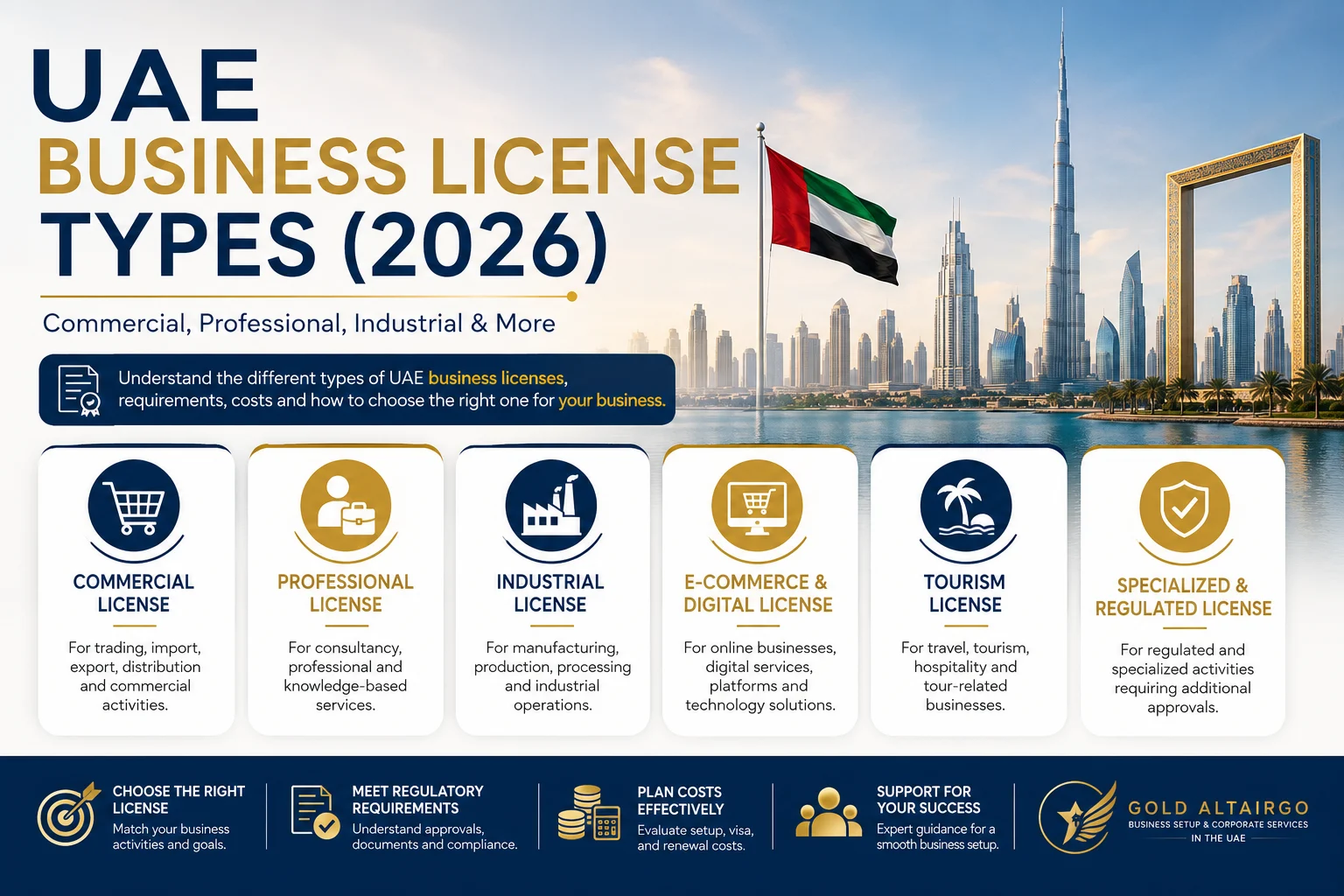
UAE Business License Types (2026): Commercial, Professional, Industrial & More
Choosing the correct business license is one of the most important decisions when establishing a company in the United Arab Emirates.
The UAE offers a broad range of licensing options designed for different commercial activities, professional services, industrial operations and specialized sectors.
Understanding the main UAE business license types can help entrepreneurs select the right structure, avoid unnecessary amendments and identify potential regulatory requirements before starting the incorporation process.
However, the appropriate license is not determined only by the name of the business.
It depends on several factors, including the proposed activities, jurisdiction, ownership structure, operational requirements, office or facility needs and whether additional government approvals are required.
A consultancy company, for example, may have very different licensing requirements from a trading company, manufacturing facility, restaurant, logistics operator or technology business.
This guide explains the major types of business licenses in the UAE in 2026, how they differ and what investors should consider before selecting a license.
What Is a UAE Business License?
A UAE business license is an official authorization that allows a company to conduct approved economic activities within the scope of its registration.
The activities appearing on the license are important because they define what the company is authorized to do.
Depending on the business, these activities may include:
1. Trading and distribution
2. Consultancy
3. Professional services
4. Technology services
5. E-commerce
6. Manufacturing
7. Industrial activities
8. Marketing
9. Education-related services
10. Tourism
11. Logistics
12. Technical services
13. Other specialized activities
The exact licensing framework depends on where the company is established.
Businesses may generally be established under a Mainland authority or within one of the UAE's Free Zones.
Each jurisdiction maintains its own activity classifications, licensing procedures, fees and operational requirements.
Therefore, investors should select both the jurisdiction and business activities carefully before completing the company formation process.
Why Choosing the Correct UAE Business License Matters
Selecting a license should not be treated as a simple administrative step.
The license can affect how the business operates after incorporation.
For example, the selected activities may influence:
1. The company's permitted operations
2. Government approval requirements
3. Office or facility requirements
4. Immigration and visa procedures
5. Banking and compliance documentation
6. Future activity amendments
7. Expansion opportunities
8. Renewal requirements and costs
Choosing an inappropriate activity or license structure may result in additional amendments later.
In some regulated sectors, the company may also need approval from another government authority before the activity can be activated or the license can be issued.
For this reason, investors should begin by defining exactly what the company will do.
What Are the Main UAE Business License Types?
The terminology and classifications can vary between Mainland authorities and individual Free Zones.
However, UAE business licenses commonly fall into several broad categories.
The most widely encountered include:
1. Commercial License
2. Professional License
3. Industrial License
4. E-commerce and digital business licenses
5. Tourism-related licenses
6. Specialized and regulated activity licenses
Some jurisdictions may use different names or combine multiple activities within particular license categories.
Therefore, the final classification should always be confirmed with the relevant licensing authority.
Let's examine the major categories individually.
1. Commercial License in the UAE
A commercial license is commonly associated with companies involved in trading and other commercial activities.
Depending on the approved activity and jurisdiction, a commercial company may conduct activities involving the purchase, sale, import, export or distribution of permitted products.
Examples may include businesses involved in:
1. General or specialized trading
2. Consumer products
3. Electronics
4. Building materials
5. Equipment
6. Automotive products
7. Food products
8. Clothing and accessories
9. Machinery
10. Wholesale activities
11. Distribution
The exact products and activities that a company may trade depend on what is approved on its license.
Who Should Consider a Commercial License?
A commercial license may be suitable for entrepreneurs whose primary business model involves buying and selling goods.
However, investors should not assume that one commercial license automatically permits every type of trading activity.
Certain products or sectors can have additional regulatory requirements.
For example, businesses dealing with particular food products, medical products or other regulated goods may need approvals or registrations beyond the basic company license.
Commercial License and Business Activities
Business activity selection is particularly important for trading companies.
Before incorporation, investors should identify:
1. What products will be traded
2. Whether the business will import or export
3. Whether products will be sold locally
4. Whether warehousing is required
5. Whether additional approvals apply
6. Whether the selected jurisdiction supports the intended activities
This prevents situations where the company is incorporated but later discovers that its license does not cover an important part of its intended operations.
2. Professional License in the UAE
A professional license is generally associated with businesses providing professional, consultancy, technical or knowledge-based services.
Instead of primarily selling physical products, these companies typically provide expertise or specialized services to clients.
Depending on the jurisdiction and activity classification, examples may include:
1. Management consultancy
2. Marketing consultancy
3. Business consultancy
4. IT consultancy
5. Technical consultancy
6. Design services
7. Accounting-related services
8. Professional advisory services
9. Other specialized service activities
The exact classification varies significantly depending on the activity.
Professional Activities May Require Qualifications
Some professional activities can require evidence that the responsible individual has appropriate qualifications or experience.
This is particularly relevant in regulated or specialized professions.
Depending on the activity, authorities may request documents such as:
1. Academic certificates
2. Professional qualifications
3. Experience certificates
4. Professional registrations
5. Additional regulatory approvals
Not every professional activity requires these documents.
The requirements should therefore be checked for the specific activity before proceeding.
Professional License vs Commercial License
The fundamental difference generally relates to the nature of the company's activities.
A commercial business typically focuses on commercial or trading operations.
A professional business generally provides expertise, consultancy or specialized services.
For example:
Trading company: sells approved products.
Consultancy company: provides approved advisory or professional services.
However, modern businesses can operate across multiple areas.
A technology company, for instance, might provide software services while also selling certain products or subscriptions.
This is why investors should not select a license based only on a general description of the company.
The actual revenue-generating activities should be reviewed first.
Can a UAE Company Have Multiple Business Activities?
In many cases, companies can include multiple activities under their license.
However, whether particular activities can be combined depends on the licensing authority, activity groups and applicable regulations.
Some activities may be compatible within the same license.
Others may require:
1. A different license category
2. Additional government approvals
3. Different premises
4. Additional documentation
5. A separate company or license
Therefore, an investor planning several business activities should check their compatibility before incorporation.
This becomes especially important for companies entering multiple sectors simultaneously.
A structure that works for a simple consultancy may not work for a business combining consultancy, trading, training, logistics and regulated technical activities.
Planning these activities correctly from the beginning can reduce unnecessary restructuring later.
3. Industrial License in the UAE
An industrial license is generally intended for businesses carrying out manufacturing, production or other industrial operations.
These businesses can have significantly different requirements from standard consultancy or trading companies.
Depending on the activity, an industrial operation may require:
1. Manufacturing premises
2. Warehouse or factory space
3. Machinery
4. Technical staff
5. Environmental requirements
6. Safety approvals
7. Municipality approvals
8. Civil Defense requirements
9. Other sector-specific authorizations
Industrial businesses therefore require more detailed planning before incorporation.
Examples of Industrial Activities
Depending on the jurisdiction and authority classifications, industrial activities may include:
1. Manufacturing
2. Product assembly
3. Processing
4. Packaging
5. Fabrication
6. Industrial production
7. Specialized manufacturing operations
The precise classification and required approvals depend on the product and production process.
Industrial License vs Commercial License
A commercial license and an industrial license serve different operational purposes.
A commercial company may purchase finished products and sell or distribute them.
An industrial company may manufacture, process or produce products.
Consider a simplified example.
A company importing finished furniture and selling it in the UAE may require a commercial trading activity.
A company manufacturing furniture from raw materials may require an industrial or manufacturing activity.
The second business can involve additional premises, equipment, safety and regulatory requirements because it is performing production rather than simply trading finished products.
This distinction can significantly affect the company's setup requirements and total investment.
Do Industrial Companies Need Additional Government Approvals?
Potentially, yes.
Industrial and manufacturing activities may involve approvals from authorities beyond the primary licensing authority.
The requirements depend on factors such as:
1. Type of manufacturing
2. Products being produced
3. Location
4. Environmental impact
5. Machinery
6. Storage requirements
7. Fire and safety considerations
8. Workforce
9. Industrial facility specifications
Investors should therefore verify the approval pathway before committing to premises or purchasing equipment.
This is particularly important because certain activities cannot begin operations simply by obtaining an initial company license.
The complete regulatory requirements must be considered as part of the overall company formation plan.
4. E-Commerce and Digital Business Licenses in the UAE
The growth of online businesses has created significant demand for e-commerce and digital business licenses in the UAE.
These licenses or activity classifications can support businesses that sell products or provide services through websites, online platforms, mobile applications or other digital channels.
Depending on the jurisdiction and selected activities, examples can include:
1. E-commerce
2. Online retail
3. Digital services
4. Software-related activities
5. Web-based services
6. Online marketplaces
7. Digital marketing
8. Technology services
9. Online consultancy
10. Other internet-based business models
However, simply operating online does not mean that every digital business requires the same type of license.
The correct activity depends on what the company actually provides or sells.
How to Choose an E-Commerce Business Activity
An entrepreneur planning an online business should first identify the underlying commercial activity.
For example, there is an important difference between:
1. An online retailer selling physical products.
2. A software company providing digital solutions.
3. A consultancy delivering services remotely.
4. A marketplace connecting buyers and sellers.
5. A digital marketing agency providing marketing services to clients.
Although all these businesses operate digitally, their licensing requirements may be different.
Investors should therefore select an activity based on the actual business model rather than choosing an e-commerce classification simply because the company uses a website.
Can an E-Commerce Company Sell Products Across the UAE?
The answer depends on the company's jurisdiction, activities, distribution model and applicable regulations.
A business should consider:
1. Where the company is registered
2. What products it sells
3. How products enter the UAE
4. Where inventory is stored
5. How orders are fulfilled
6. Whether local distribution arrangements are required
7. Whether the products themselves require approval
Certain product categories can also be subject to additional regulatory requirements.
Therefore, the licensing structure should be aligned with the entire supply chain rather than only the online storefront.
5. Tourism-Related Business Licenses
Tourism is an important sector within the UAE economy.
Businesses operating in tourism-related activities can require specific licensing and regulatory approvals depending on the emirate and service being offered.
Activities may include areas such as:
1. Travel-related services
2. Tourism services
3. Tour operations
4. Destination services
5. Hospitality-related activities
6. Other tourism businesses
These activities should not automatically be treated like standard consultancy or trading activities.
Depending on the activity, additional requirements may apply.
Investors planning a tourism business should confirm the applicable licensing authority and sector-specific requirements before establishing the company.
6. Specialized and Regulated Business Activities
Not every UAE business fits neatly into commercial, professional or industrial classifications.
Many sectors have specialized regulatory requirements.
Examples can include certain activities within:
1. Healthcare
2. Education
3. Financial services
4. Transport
5. Food
6. Construction
7. Engineering
8. Real estate
9. Security
10. Energy
11. Environmental services
12. Industrial services
13. Telecommunications
14. Other regulated sectors
In these cases, obtaining the company license may involve more than approval from the primary licensing authority.
What Is an External Approval?
An external approval is an authorization that may be required from another competent government or regulatory authority for a particular activity.
The exact authority depends on the sector.
For example, a specialized activity could require technical, professional, safety, health, environmental or sector-specific approval.
This can affect:
1. Required documents
2. Qualifications
3. Premises
4. Equipment
5. Staffing
6. Processing time
7. Setup cost
This is why entrepreneurs should check external approval requirements before making significant financial commitments.
Why External Approvals Matter Before Company Formation
Suppose an investor selects a regulated business activity and immediately leases a large commercial facility.
Later, the relevant regulator may require a different facility specification or location.
That can create unnecessary costs.
A better approach is to understand the approval pathway first.
The investor can then coordinate the company formation, premises, documentation and regulatory requirements in the correct sequence.
This is particularly important for specialized businesses where licensing is only one part of the overall approval process.
UAE Mainland Business License
A Mainland company is generally licensed through the relevant economic authority of the emirate where the company is established.
For example, a business established in Dubai Mainland operates within Dubai's Mainland licensing framework.
Mainland companies can be suitable for businesses that want to establish a strong local operational presence in the UAE.
Depending on the activities and structure, Mainland businesses may be appropriate for:
1. Trading
2. Consultancy
3. Professional services
4. Contracting
5. Retail
6. Restaurants
7. Technical services
8. Industrial activities
9. Other local commercial operations
However, requirements differ substantially between activities.
UAE Free Zone Business License
The UAE has numerous Free Zones, each with its own licensing framework, activity list, packages and operational requirements.
A UAE Free Zone license may be attractive to entrepreneurs seeking a structured company formation package or a jurisdiction focused on particular industries.
Free Zones can support activities such as:
1. Consultancy
2. Trading
3. Technology
4. Media
5. E-commerce
6. Professional services
7. Logistics
8. Industrial activities
9. Other specialized sectors
However, not every Free Zone offers every activity.
The appropriate Free Zone should therefore be selected according to the company's actual business requirements.
Mainland vs Free Zone Business License
One of the most common questions entrepreneurs ask is whether they should choose a Mainland or Free Zone license.
There is no universal answer.
The right option depends on the company's activities and commercial objectives.
A Mainland structure may be considered when:
1. The company requires a particular Mainland activity
2. The business needs a physical local operating presence
3. The planned activity or customer model is better suited to Mainland
4. Specific premises are required
5. The company expects significant local operations
A Free Zone structure may be considered when:
1. The required activity is available within a suitable Free Zone
2. The business wants a Free Zone incorporation structure
3. The available package fits its visa and workspace requirements
4. The company's operational model is compatible with the Free Zone
5. The decision should therefore be based on business requirements
rather than simply choosing whichever license has the lowest advertised starting price.
How Business Activities Determine Your UAE License
The business activity is one of the foundations of UAE company formation.
An investor should clearly identify what the company will actually do before selecting the license.
For example, saying:
"I want to start a technology company"
is usually not specific enough.
The company might develop software, provide IT consultancy, sell hardware, operate an online platform or provide cybersecurity services.
Those operations may correspond to different activities.
A more useful starting point is to describe:
1. What the company sells
2. What services it provides
3. Who its customers are
4. How it generates revenue
5. Whether it imports products
6. Whether it manufactures anything
7. Whether it requires employees
8. Whether it needs physical premises
This information helps determine which activities should be considered.
Should You Add Many Activities to a UAE Business License?
Adding numerous activities can appear attractive because it gives the company a broader scope.
However, more activities are not always better.
Additional activities may:
1. Increase licensing costs
2. Create additional approval requirements
3. Require different documentation
4. Complicate the company structure
5. Create unnecessary compliance obligations
The objective should be to select the activities the company genuinely expects to conduct.
Businesses can evaluate additional activities later as they expand.
Can You Add Activities After the Company Is Established?
In many cases, yes.
Companies may be able to amend their licenses and add new activities after incorporation.
The procedure depends on the jurisdiction and activity.
An amendment may involve:
1. Selecting the new activity
2. Checking compatibility with existing activities
3. Obtaining initial approval where required
4. Securing external approvals if applicable
5. Updating company documents where necessary
6. Paying amendment and licensing fees
7. Receiving the amended license
If the new activity belongs to a very different regulatory category, additional restructuring may be required.
Therefore, businesses planning rapid expansion should consider future activities when selecting their initial jurisdiction.
Business License and Office Requirements
The selected business license can also influence workspace requirements.
Some businesses can operate using flexible workspace arrangements where permitted.
Others may require:
1. Dedicated offices
2. Retail premises
3. Warehouses
4. Workshops
5. Clinics
6. Training facilities
7. Restaurants
8. Industrial facilities
9. Other specialized premises
The required facility depends on the activity and applicable authority rules.
A consultancy with a small team will usually have different premises requirements from a manufacturing company employing dozens of workers.
Business License and UAE Residence Visas
Entrepreneurs frequently choose a company formation package partly based on the number of residence visas they expect to require.
However, visa capacity should be considered together with the company's overall structure.
Potential factors can include:
1. Jurisdiction
2. Company package
3. Workspace
4. Establishment requirements
5. Employee requirements
6. Immigration rules
7. Company activity
A business expecting significant hiring should therefore consider future staffing requirements before selecting the cheapest available setup package.
The initial license cost may be attractive, but changing the structure later can create additional expense.
Does Every UAE Business License Include Visas?
No.
Investors should carefully review what is actually included in a company formation package.
An advertised license price may not necessarily include every cost associated with establishing and operating the company.
Depending on the package and jurisdiction, additional expenses can potentially include:
1. Establishment or immigration procedures
2. Residence visa processing
3. Medical fitness testing
4. Emirates ID procedures
5. Health insurance
6. Workspace
7. Additional activities
8. Regulatory approvals
9. Document preparation
10. Annual renewal
Therefore, investors should compare the complete setup cost, not simply the advertised license price.
How Much Does a UAE Business License Cost in 2026?
The cost of a UAE business license in 2026 depends on much more than the license category itself.
Two businesses holding similar types of licenses can have very different total setup costs.
The final budget can depend on factors such as:
1. Mainland or Free Zone jurisdiction
2. Emirate
3. Selected business activities
4. Number of activities
5. Legal structure
6. Number of shareholders
7. Visa requirements
8. Workspace requirements
9. External approvals
10. Immigration procedures
11. Documentation requirements
12. Regulatory requirements
13. Annual renewal costs
For this reason, investors should avoid comparing company formation options using only the advertised starting license price.
License Price vs Total UAE Company Setup Cost
A common mistake is assuming that the advertised license price represents the complete cost of establishing a company.
It may not.
Depending on the jurisdiction, activity and package, the total setup can involve several components.
These may include:
1. Business license
2. Company registration
3. Name reservation
4. Incorporation documents
5. Establishment or immigration procedures
6. Workspace
7. Residence visas
8. Medical fitness procedures
9. Emirates ID procedures
10. Insurance where applicable
11. External approvals
12. Document legalization or attestation
13. Additional activity fees
14. Professional or regulatory requirements
Investors should therefore request a clear breakdown of both the initial company formation cost and the expected annual renewal cost.
What Is the Cheapest UAE Business License?
The cheapest license is not necessarily the best license.
Some company formation packages are designed for entrepreneurs who require:
1. A small number of activities
2. No employees initially
3. Limited visa requirements
4. Flexible workspace
5. A simple corporate structure
These packages can be appropriate for certain startups, consultants and digital businesses.
However, a company planning to hire employees, lease commercial premises, import products or conduct regulated activities may require a more comprehensive setup.
Selecting an unsuitable structure only because it has a lower starting price can result in additional amendments and costs later.
The better question is:
Which UAE business license provides the right structure for the company's activities and future plans at a reasonable total cost?
UAE Business License Renewal
Obtaining the license is only the beginning of the company's compliance lifecycle.
A UAE company normally needs to maintain its license and other applicable registrations according to the requirements of its jurisdiction and activities.
Renewal costs can potentially involve:
1. License renewal
2. Workspace renewal
3. Establishment or immigration-related renewals
4. Employee and residence visa costs
5. Insurance
6. Regulatory permits
7. Professional approvals
8. Accounting and compliance
9. Corporate Tax obligations
10. VAT obligations where applicable
The exact requirements depend on the company.
Businesses should therefore include recurring compliance expenses in their financial planning from the beginning.
What Happens If a UAE Business License Expires?
Businesses should avoid allowing their licenses to expire without understanding the consequences.
Depending on the jurisdiction and circumstances, an expired license can potentially affect the company's ability to conduct normal business procedures and may result in additional administrative requirements or penalties.
It can also complicate matters involving:
1. Company amendments
2. Employee procedures
3. Immigration transactions
4. Regulatory approvals
5. Banking or compliance reviews
6. Contracts
7. Other corporate procedures
Companies should monitor their renewal dates and begin preparing the required documents before expiration.
UAE Business License and Corporate Bank Account
Obtaining a business license does not automatically guarantee approval for a corporate bank account.
Banks conduct their own compliance and risk assessments.
They may review information such as:
1. Business activities
2. Company ownership
3. Shareholder profiles
4. Source of funds
5. Expected transactions
6. Customers
7. Suppliers
8. Target markets
9. Contracts or invoices
10. Business plan
11. Website
12. Office arrangements
13. Corporate documents
The business activity shown on the license should therefore accurately reflect the company's actual operations.
A clear and consistent business model can also make it easier to explain the company's operations during banking compliance reviews.
UAE Business License and Corporate Tax
Business licensing and taxation are separate areas of compliance.
Obtaining a company license does not remove the need to evaluate the company's tax obligations.
Businesses should determine which requirements apply to their circumstances, including:
1. Corporate Tax registration
2. Corporate Tax return requirements
3. Record keeping
4. VAT registration where applicable
5. VAT returns where applicable
6. Accounting records
7. Other relevant tax obligations
Free Zone companies should also avoid assuming that being incorporated in a Free Zone automatically means that every type of income is treated the same for tax purposes.
Tax treatment depends on the applicable rules and the company's circumstances.
Professional tax advice may therefore be appropriate where the position is complex.
UAE Business License and VAT
VAT requirements should also be considered separately from company licensing.
Whether a business must register for VAT depends on the applicable UAE tax rules and the company's circumstances.
Businesses should maintain appropriate financial records and monitor their taxable activities.
This becomes particularly important as the company grows.
Good accounting practices from the beginning can make future tax registration and reporting significantly easier.
Can Foreign Investors Own 100% of a UAE Company?
The UAE provides extensive opportunities for foreign investors to establish and own companies.
However, investors should not assume that every activity, jurisdiction and legal structure follows identical ownership rules.
The appropriate structure should be confirmed according to:
1. Selected activity
2. Jurisdiction
3. Legal form
4. Regulatory requirements
5. Applicable ownership rules
Free Zones also have their own incorporation frameworks.
For international investors, ownership should therefore be evaluated together with licensing, banking, taxation and operational requirements.
Can One Company Have Multiple Business Activities?
In many cases, a company can hold multiple activities.
However, activity compatibility is important.
Some activities can be combined under the same license, while others may fall into different categories or regulatory frameworks.
Factors that can affect compatibility include:
1. Activity classification
2. Licensing authority rules
3. Regulatory approvals
4. Legal structure
5. Premises requirements
6. Professional requirements
Investors planning several business lines should check whether the proposed activities can be combined before incorporating the company.
In some cases, separate licenses or entities may provide a more appropriate structure.
How to Choose the Right UAE Business License in 2026
Choosing the correct license becomes easier when the decision is approached systematically.
Step 1: Define the Exact Business Model
Describe exactly what the company will sell or provide.
Avoid broad descriptions such as "general services" or "technology."
Identify the actual revenue-generating activities.
Step 2: Identify the Appropriate Activities
Match the business model with the available licensing activities.
Check whether several activities need to be included.
Step 3: Check Whether the Activities Are Regulated
Determine whether external approvals, professional qualifications or specialized premises may be required.
This should happen early in the process.
Step 4: Compare Mainland and Free Zone Options
Evaluate both structures where appropriate.
Consider operations, customers, activities, workspace, visas and expansion plans.
Step 5: Determine Workspace Requirements
Identify whether the business can use a flexible workspace or requires a dedicated office, retail unit, warehouse or specialized facility.
Step 6: Estimate Visa Requirements
Consider both immediate and future staffing requirements.
A structure suitable for one entrepreneur may not be appropriate for a company planning to employ 20 people.
Step 7: Calculate the Complete Setup Cost
Compare more than the license fee.
Consider:
License + registration + workspace + establishment procedures + visas + approvals + compliance + renewal.
Step 8: Consider Banking Requirements
Think about the expected customers, suppliers, countries, currencies and transaction volumes.
The company's legal and licensing structure should make commercial sense.
Step 9: Consider Tax and Accounting Requirements
Plan for accounting, Corporate Tax and VAT obligations where applicable.
Step 10: Consider Future Expansion
Think beyond the first year.
Ask whether the structure can support:
1. Additional employees
2. New activities
3. Larger premises
4. New shareholders
5. UAE expansion
6. GCC expansion
7. International operations
A slightly more suitable structure today can potentially prevent expensive restructuring later.
Common UAE Business License Mistakes to Avoid
Entrepreneurs can reduce unnecessary complications by avoiding several common mistakes.
1. Choosing the Cheapest License Without Checking the Activity
Price should not determine the structure before the business activity has been confirmed.
2. Selecting an Activity That Does Not Match the Business
The licensed activity should accurately reflect what the company actually intends to do.
3. Ignoring External Approvals
Regulated activities can require additional approvals before the business becomes fully operational.
4. Underestimating Visa Requirements
A low-cost package with limited capacity may become unsuitable as the company expands.
5. Ignoring Workspace Requirements
Some activities require specific types of premises.
6. Looking Only at First-Year Costs
Renewal and ongoing compliance costs should also be considered.
7. Assuming the License Guarantees a Bank Account
Banking approval is a separate compliance process.
8. Adding Unnecessary Activities
More activities can create additional costs or requirements without providing meaningful commercial benefit.
9. Ignoring Tax Compliance
Company formation should be followed by proper assessment of the company's tax and accounting obligations.
10. Choosing a Jurisdiction Without Considering Future Growth
The structure should support the company's medium- and long-term objectives.
UAE Business License Checklist for Investors
Before proceeding with company formation, investors should be able to answer the following questions:
1. What exactly will the company do?
2. Which activities are required?
3. Is the activity commercial, professional, industrial or specialized?
4. Is Mainland or Free Zone more appropriate?
5. Are external approvals required?
6. What legal structure is suitable?
7. How many shareholders will there be?
8. How many visas are required?
9. What workspace is needed?
10. Will products be imported or distributed?
11. Is a warehouse required?
12. Are professional qualifications required?
13. What is the complete first-year cost?
14. What is the expected renewal cost?
15. What tax and accounting requirements apply?
16. What banking requirements should be considered?
17. Will additional activities be required later?
18. Will the company expand across the UAE or GCC?
Answering these questions before incorporation can make the company formation process much more structured.
How Gold Altairgo Can Help With UAE Business Licensing
Gold Altairgo supports entrepreneurs, investors, SMEs and international companies evaluating business establishment and expansion opportunities in the UAE.
Our business setup support can include:
1. Business activity assessment
2. Mainland and Free Zone comparison
3. Company formation guidance
4. Business licensing support
5. Corporate structure guidance
6. Visa and immigration guidance
7. Workspace requirement assessment
8. External approval coordination
9. Shareholder and corporate amendments
10. Corporate Tax and VAT support
11. Ongoing corporate and compliance services
12. UAE and GCC expansion support
Rather than selecting a company structure based only on an advertised starting price, investors should evaluate the complete operational requirements of the proposed business.
This helps establish a structure aligned with the company's activities, staffing requirements, commercial objectives and future expansion plans.
Conclusion: Which UAE Business License Should You Choose in 2026?
There is no single best UAE business license for every entrepreneur.
The correct choice depends on what the company actually intends to do.
A trading company may require a commercial structure.
A consultancy or professional service provider may require a professional activity.
A manufacturing operation may require an industrial license and specialized premises.
An online company may need an e-commerce or activity-specific structure.
A regulated business may require additional approvals from competent authorities.
The most important step is therefore not simply finding the cheapest license.
It is choosing the right business activity, jurisdiction and company structure from the beginning.
Before proceeding, compare:
Business activities + jurisdiction + legal structure + workspace + visas + regulatory approvals + banking + tax + renewal + future expansion.
This provides a much more realistic picture of the company's requirements than the advertised license fee alone.
Gold Altairgo can assist entrepreneurs and international companies in evaluating UAE Mainland and Free Zone options and developing a company formation structure based on their specific activities, operational requirements and expansion objectives.
UAE Company Formation (2026): Complete Guide to Starting a Business in the UAE
Mainland vs Free Zone in UAE (2026): Which Is Right for Your Business?
Business Setup in Dubai (2026): Costs, Licenses & Step-by-Step Guide
Dubai Mainland Company Formation (2026): Cost, License, Visa & Setup Guide
UAE Free Zone Company Setup Cost (2026): License, Visa & Complete Cost Guide
10 Common UAE Business Setup Mistakes (2026): How to Avoid Costly Errors
For the full end-to-end process, see our pillar guide: how to start a company in the UAE.
Frequently asked questions
What are the main types of business licenses in the UAE?
UAE business licenses commonly include commercial, professional and industrial licenses, alongside e-commerce, tourism and other specialized or regulated activity licenses. The exact classifications available depend on the licensing authority and jurisdiction.
What is a commercial license in the UAE?
A commercial license is commonly used for approved trading and commercial activities. Depending on the licensed activities, this can include buying, selling, importing, exporting or distributing permitted goods.
What is a professional license in the UAE?
A professional license is generally associated with consultancy, professional, technical or knowledge-based services. Requirements vary by activity, and certain specialized professions may require qualifications, experience or additional regulatory approvals.
What is an industrial license in the UAE?
An industrial license is generally intended for manufacturing, production, processing and other qualifying industrial activities. These businesses may require specialized premises, equipment and additional regulatory or safety approvals.
Which UAE business license is best for an e-commerce company?
The appropriate license depends on what the online business actually does. An online retailer, software company, digital agency and online consultancy can require different activities even though they all operate digitally.
Can I have multiple activities on one UAE business license?
Multiple activities can often be included, but compatibility depends on the licensing authority, activity classifications and regulatory requirements. Some combinations may require additional approvals or a different licensing structure.
What is the difference between a Mainland and Free Zone business license?
Mainland and Free Zone companies operate under different licensing frameworks. The appropriate structure depends on the company's activities, customers, premises, visa requirements, operational model and future expansion plans.
How much does a UAE business license cost in 2026?
The cost depends on the jurisdiction, activities, legal structure, workspace, visa requirements and external approvals. Investors should compare the complete setup and renewal cost rather than only the advertised license price.
Do UAE business licenses require external approvals?
Some regulated or specialized activities require approvals from additional competent authorities. Requirements can relate to professional qualifications, premises, safety, health, environmental standards or other sector-specific regulations.
Can Gold Altairgo help me choose the right UAE business license?
Yes. Gold Altairgo can assist with business activity assessment, Mainland and Free Zone comparison, company formation, licensing, external approval coordination, visa guidance, corporate amendments, tax support and ongoing corporate services.
Continue exploring
Related services
- Company FormationMainland, Free Zone, Offshore, branch and representative office setup across the UAE and GCC.
- Corporate AdvisoryStructuring, M&A, shareholder restructuring and expansion advisory for boards and founders.
- Business Admin & Back-OfficeMonthly outsourced administration and structured back-office support for UAE SMEs and growing companies.
Country guides
Related articles

UAE Trade License Amendment 2026: Add Activities, Change Shareholders & Update Company Details
Adding an activity, changing shareholders or updating your trade name? How UAE licence amendments work, what drives cost and timing, and how to plan the change.
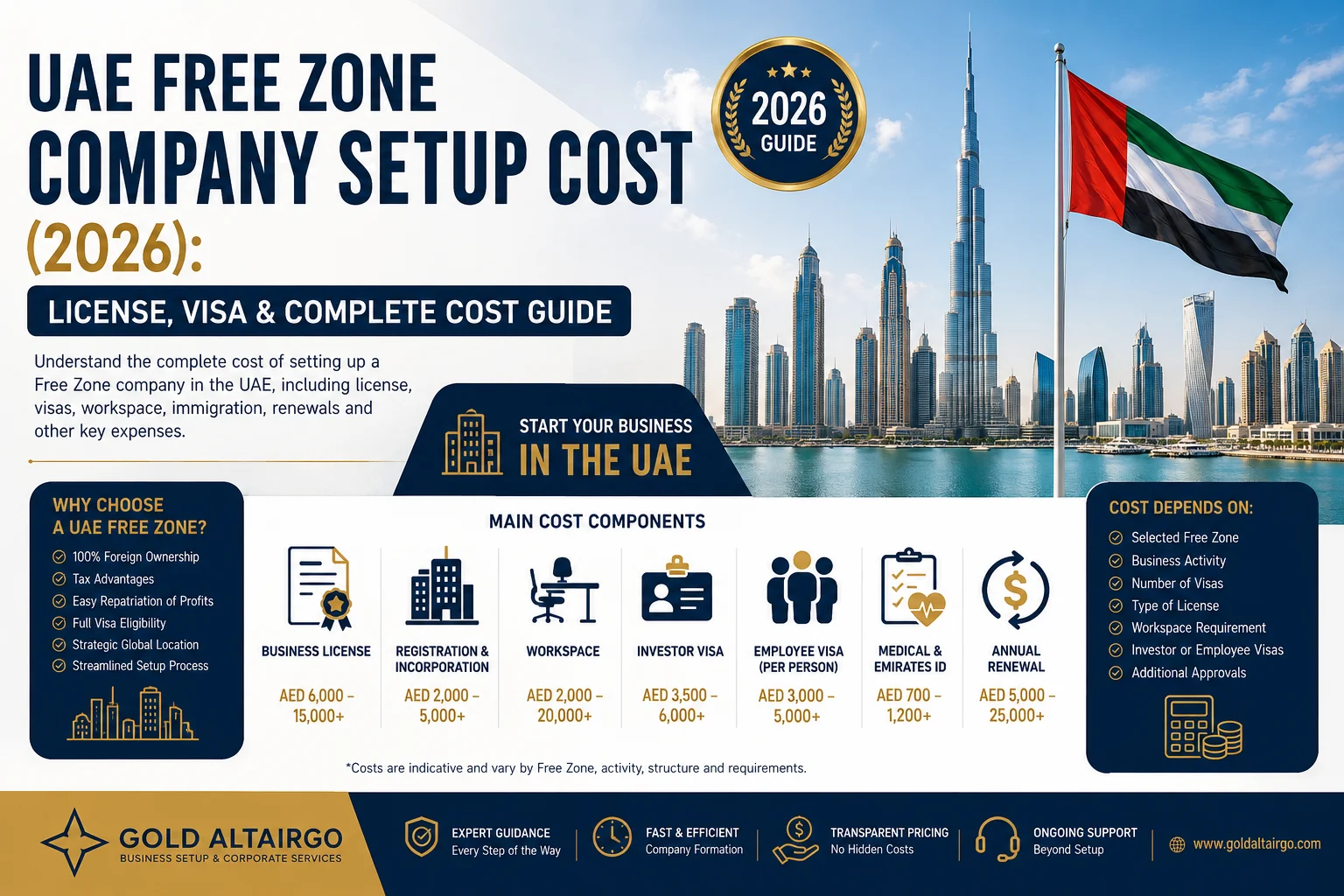
UAE Free Zone Company Setup Cost (2026): License, Visa & Complete Cost Guide
Understand the UAE Free Zone company setup cost in 2026, including license fees, visas, workspace, immigration, renewal costs and other expenses investors should consider.
Dubai Business License Cost (2026): Complete Breakdown of Setup, Visa & Renewal Fees
Discover the Dubai business license cost in 2026, including Mainland and Free Zone setup expenses, visas, office requirements, government approvals, renewal fees and other costs investors should consider.
Stay ahead with UAE business insights
Monthly briefings from our advisory team: regulatory updates, tax alerts, growth strategies and market opportunities across the UAE and GCC.
- • Business updates and regulatory news
- • Corporate Tax and VAT insights
- • Growth strategies and market opportunities