
VAT Registration in UAE: Requirements, Process & Guide
How VAT registration in UAE works in 2026: mandatory and voluntary FTA thresholds, who must register, required documents, the EmaraTax application steps and what happens after you receive your TRN.

VAT registration in UAE is the formal process of registering a business with the UAE Federal Tax Authority (FTA) so that it can charge, collect and account for value added tax. Since VAT was introduced in the UAE at a standard rate of 5%, registration has become one of the first compliance questions every founder, finance manager and international investor has to answer.
Two answers matter. The first is whether you must register: UAE-resident businesses generally have to register once taxable supplies and imports pass the mandatory threshold of AED 375,000. The second is whether you may register: voluntary registration is generally available from AED 187,500, which many start-ups use to recover input VAT and to trade credibly with larger counterparties.
This guide explains who needs to register, how the thresholds are tested, how the EmaraTax application works step by step, what information is commonly requested, and what happens once your Tax Registration Number (TRN) is issued.
Informational disclaimer
- ! VAT rules and administrative procedures may change. Businesses should confirm their specific obligations with the UAE Federal Tax Authority or obtain professional tax advice before acting.
How do I register for VAT in the UAE? (quick answer)
- 1 Confirm you meet a registration test: mandatory from AED 375,000, voluntary from AED 187,500 of taxable supplies and imports (or qualifying taxable expenses for the voluntary route).
- 2 Create or access your account on EmaraTax, the Federal Tax Authority online tax platform.
- 3 Create or open the Taxable Person profile for the entity that will hold the registration.
- 4 Select the VAT registration service and complete the application with licence, ownership, activity, turnover, bank and contact details.
- 5 Upload the supporting documents requested, review every figure for consistency and submit.
- 6 Respond to any FTA clarification requests; on approval your Tax Registration Number (TRN) and VAT certificate become available in the account.
The same federal process applies whether you are registering for VAT in Dubai, Abu Dhabi, Sharjah or any other emirate. The detailed walkthrough is in the step-by-step section below.
VAT Registration in UAE: Quick Overview
The table below summarises the core reference points for VAT registration in the UAE, based on current Federal Tax Authority guidance.
| Topic | Key information |
|---|---|
| Mandatory registration threshold | AED 375,000 of taxable supplies and imports over the previous 12 months, or expected to be exceeded in the next 30 days (UAE-resident businesses) |
| Voluntary registration threshold | AED 187,500 of taxable supplies and imports, or qualifying taxable expenses, on the same 12-month or 30-day tests |
| Authority | UAE Federal Tax Authority (FTA), a federal body — VAT is not administered emirate by emirate |
| Registration platform | EmaraTax, the FTA online tax services platform |
| Standard VAT rate | 5%, with zero-rated and exempt categories defined in the VAT legislation |
| Application deadline | Current FTA service guidance states that a person required to register must submit the application within 30 days of becoming required to register |
| Return and payment deadline | Generally within 28 days from the end of the applicable tax period; the tax period assigned depends on the taxpayer circumstances and FTA requirements |
| Outcome of approval | Tax Registration Number (TRN) and VAT registration certificate available through the account |
Official rules and the current application service are published by the UAE Federal Tax Authority (external, tax.gov.ae). Gold Altairgo is an independent advisory firm and is not affiliated with the FTA or any UAE government body.
Who Needs to Register for VAT in the UAE?
Any UAE-resident business whose taxable supplies and imports exceed AED 375,000 over the previous 12 months, or are expected to exceed it within the next 30 days, must register for VAT. Businesses below that level may register voluntarily from AED 187,500, and some non-resident businesses supplying into the UAE face registration requirements regardless of value.
The starting point is the concept of a taxable person making taxable supplies in the UAE. A taxable supply is broadly a supply of goods or services made in the UAE that is not exempt, including supplies taxed at 0%. Imports can also count towards the threshold tests.
For UAE-resident businesses, the tests are applied in two directions at once:
- The historic test: the value of taxable supplies and imports over the previous 12 months, measured on a rolling basis rather than only at financial year end.
- The forward-looking test: whether the relevant threshold is expected to be exceeded within the next 30 days.
Because the historic test rolls forward every month, a business can become liable to register mid-year even if annual budgets suggested otherwise. Monitoring turnover monthly is the practical safeguard.
Mandatory VAT Registration
Mandatory registration generally applies to a UAE-resident business where the total value of its taxable supplies and imports exceeded AED 375,000 over the previous 12 months, or where it is expected to exceed AED 375,000 in the next 30 days. Once either test is met, registration is an obligation rather than a choice, and current FTA service guidance requires the application to be submitted within 30 days of becoming required to register.
Voluntary VAT Registration
A UAE-resident business that has not reached the mandatory threshold may generally apply for voluntary registration where taxable supplies and imports, or qualifying taxable expenses, exceeded AED 187,500 over the previous 12 months, or are expected to exceed AED 187,500 in the next 30 days. The expenses route matters for early-stage companies that are spending on set-up, equipment and services before revenue arrives.
Voluntary registration is a real commitment: the same invoicing, record-keeping, filing and payment obligations apply as for a mandatory registrant.
VAT Registration for Non-Resident Businesses
The AED 375,000 threshold should not be applied universally to businesses that are not resident in the UAE. Non-resident businesses making taxable supplies in the UAE can face different registration requirements. In particular, where no other person is responsible for accounting for the VAT due on those supplies, registration may be required regardless of the value of the supplies.
If you supply into the UAE from abroad — including digital services, e-commerce sales or project-based services — your position should be assessed on the specific facts rather than by reference to the resident thresholds.
How to Calculate the UAE VAT Registration Threshold
Threshold calculations go wrong more often than the application itself. At a high level, the calculation looks at the value of taxable supplies, not simply at everything that appears as revenue in the accounts.
- Standard-rated supplies are included at their value.
- Zero-rated supplies are still taxable supplies and are generally included, even though the VAT charged is 0%.
- Imports of goods and services can count towards the tests where relevant.
- Exempt supplies should not simply be treated as taxable turnover; they are a different category and require care.
- Taxable expenses are relevant to the voluntary registration route, not to the mandatory test.
Example only. A Dubai-based consultancy invoices AED 300,000 to UAE clients and AED 60,000 to clients abroad over the previous 12 months, and holds a signed contract expected to add AED 40,000 within the next 30 days. Looking only at the historic UAE invoices, the business appears to be below the mandatory threshold. Adding the other taxable supplies and the forward-looking contract changes the picture, and the mandatory test needs to be examined properly. This illustration is not tax advice and the correct treatment depends on the facts.
If you want to model the wider cost of compliance alongside setup and visa planning, our UAE business calculators and assessment centre can help you frame the numbers before you commit.
How to Register for VAT in UAE: Step-by-Step
VAT registration applications are made online through EmaraTax, the Federal Tax Authority digital tax services platform. The sequence below reflects the current published process. Nothing here guarantees approval or a particular processing time.
Access or create your EmaraTax account
Log in to the FTA EmaraTax platform, or create a new user account if the business has never interacted with the FTA before.
Create or access the Taxable Person profile
A Taxable Person profile represents the entity that will hold the registration. Existing profiles can be reused; new entities need one created.
Open the Taxable Person account
Enter the relevant Taxable Person account so that tax-type registrations become available.
Select VAT registration
Choose the VAT registration service from the available tax types and begin a new application.
Complete the VAT registration application
Provide entity details, licence information, ownership and management details, business activities, contact and bank details, and turnover information as requested.
Provide the requested supporting information and documents
Upload the evidence the form asks for. Requirements vary with legal form, activity and circumstances.
Review the application carefully
Check that names, licence data, ownership, activity descriptions and financial figures are consistent across every document. Inconsistency is the most common cause of follow-up queries.
Submit the application
Submit through EmaraTax and keep the reference for tracking.
Respond to any FTA requests for further information
The FTA may ask for clarification or additional evidence. Prompt, complete responses reduce delay.
Access your TRN and VAT registration certificate if approved
Where the application is approved, the Tax Registration Number and certificate become available through the account.
Documents and Information Commonly Needed for UAE VAT Registration
There is no single rigid document list that applies to every applicant. What the FTA asks for depends on the legal form of the entity, its ownership, its business activity, its transaction history, the circumstances of the application and any specific requests raised during review. The groups below are commonly requested or potentially required rather than universally mandatory.
Commonly requested information
- ✔ Company and legal information: trade licence, memorandum or articles of association, certificate of incorporation where applicable, registered address details
- ✔ Owner and signatory information: passport and Emirates ID copies for owners, partners and authorised signatories, and evidence of signing authority
- ✔ Business activity information: licensed activities, description of what the business actually sells, customer profile and locations served
- ✔ Financial and turnover evidence: revenue figures for the relevant periods, supported by financial statements, management accounts, audit reports or similar records
- ✔ Bank and contact information: UAE bank account details in the entity name where requested, plus the contact details used for FTA correspondence
- ✔ Supporting transaction evidence: sample invoices, contracts, purchase orders, import or customs documentation and expense records supporting the declared figures
Assemble the evidence before starting the form. An application supported by consistent figures across licence, accounts and invoices is far easier to review than one where the numbers have to be reconciled by the reviewer.
VAT Registration for a New Company in UAE
Incorporating a company does not, by itself, create an obligation to register for VAT. A new entity applies exactly the same tests as an established one: the AED 375,000 mandatory test on the previous 12 months or the next 30 days, and the AED 187,500 voluntary test on supplies or qualifying taxable expenses.
Practical points for founders in their first year:
- Forecast realistically. A signed pipeline that pushes you past AED 375,000 within 30 days triggers the mandatory test even if historic revenue is nil.
- Consider the expenses route. Set-up costs, professional fees, equipment and office spend can support voluntary registration where qualifying taxable expenses exceed AED 187,500.
- Weigh the trade-off. Voluntary registration allows recovery of input VAT where recoverable and can help with B2B credibility, but it brings permanent filing and record-keeping duties.
- Keep evidence from day one. Contracts, invoices and bank records are what support the figures you declare.
- Monitor the rolling 12 months monthly. This is the single most effective habit for avoiding a late application.
If you are still at the formation stage, our complete UAE company registration and formation guide covers licensing, structure and banking, and the UAE compliance checklist sets out the recurring obligations that follow registration.
VAT Registration in Dubai vs Other UAE Emirates
Searches for "VAT registration Dubai" are extremely common, but there is no separate Dubai VAT system. VAT is a federal tax administered by the Federal Tax Authority across all seven emirates. A company licensed by Dubai Economy and Tourism, by a Dubai free zone, or by an authority in Abu Dhabi, Sharjah, Ajman, Ras Al Khaimah, Fujairah or Umm Al Quwain, all use the same thresholds, the same EmaraTax platform and the same rules.
What can differ between emirates is the licensing documentation you hold, not the VAT registration framework itself. When guidance suggests a Dubai-specific VAT registration route, treat it with caution.
VAT Registration in Dubai
Businesses licensed by Dubai Economy and Tourism or by a Dubai free zone apply the federal AED 375,000 mandatory and AED 187,500 voluntary tests and submit through EmaraTax. What is Dubai-specific is the paperwork you attach: the DET or free zone licence, the establishment card and the lease or Ejari-type tenancy evidence issued by the Dubai authority. Dubai companies with a mix of local, GCC and export revenue should review how zero-rated and export supplies feed into the threshold before applying. Setup budgeting for a Dubai entity is covered in our Dubai business setup cost guide.
VAT Registration in Abu Dhabi
VAT registration in Abu Dhabi follows exactly the same federal framework. An entity licensed by the Abu Dhabi Department of Economic Development, ADGM or a free zone such as KEZAD or Masdar City registers with the Federal Tax Authority, not with an emirate-level tax office. Abu Dhabi entities frequently work on government, energy and contracting mandates, where large single contracts can push a business over the mandatory threshold on the forward-looking 30-day test well before annual accounts suggest it. Contract-by-contract monitoring is the practical safeguard.
VAT Registration in Sharjah
The same applies to VAT registration in Sharjah. Companies licensed by the Sharjah Economic Development Department, SAIF Zone, Hamriyah Free Zone or Sharjah Publishing City use the federal thresholds and the same EmaraTax application. Sharjah has a high concentration of trading, manufacturing and logistics businesses, where imports and movements of goods matter to both the threshold calculation and to how supplies are treated, so import records should be reconciled with the declared turnover before submission.
Other Emirates
Ajman, Ras Al Khaimah, Fujairah and Umm Al Quwain entities register on identical terms. There is no emirate-level VAT registration, no emirate-specific threshold and no separate emirate portal.
Mainland vs Free Zone VAT Registration
Being licensed in a free zone does not automatically remove VAT registration obligations. Free zone companies apply the same threshold tests as mainland companies, and many are registered for VAT.
Where free zones can differ is in the VAT treatment of particular transactions. That treatment can depend on:
- the type of supply and whether it involves goods or services
- the locations of the supplier, the recipient and the goods
- whether a Designated Zone is involved, which is a specific VAT concept with its own conditions rather than a general free zone benefit
- the wider circumstances of the transaction, including movement of goods and place of supply
Designated Zone rules should not be summarised as "free zones do not pay VAT". Transactions need to be assessed individually. If you are choosing between structures, our mainland vs free zone comparison explains the broader trade-offs.
VAT Groups, TRN Timing and Deregistration
Some related UAE entities may consider applying as a VAT group rather than maintaining separate registrations. Eligibility, control relationships and the practical effect on reporting should be assessed before the application is submitted; grouping is not automatic merely because companies share owners.
A business must not charge VAT or issue VAT tax invoices before its registration is effective and its Tax Registration Number (TRN) is issued. After registration, the TRN should appear on compliant tax documents. If the business later ceases taxable activity or falls below the applicable deregistration tests, it should assess whether VAT deregistration is required and apply within the relevant deadline.
What Happens After VAT Registration?
Approval is the beginning of an ongoing compliance cycle, not the end of the exercise.
- TRN and certificate. Your Tax Registration Number and VAT registration certificate become available through your account and are used on tax invoices and in dealings with the FTA.
- Tax invoices. Where applicable, supplies must be invoiced in the required form, showing VAT correctly.
- Accounting records. Books, invoices, credit notes, import records and supporting documents must be kept in line with the record-keeping requirements.
- VAT returns. Returns are filed for each applicable tax period. The tax period assigned to a taxpayer depends on its circumstances and FTA requirements — it is not accurate to say that every company files quarterly.
- Payments. VAT returns and related VAT payments are generally due within 28 days from the end of the applicable tax period.
- Keeping registration details current. Changes to activity, ownership, address, contact details or business circumstances may need to be reflected in your registration.
Corporate tax obligations run alongside VAT for most UAE businesses. Our guide to UAE corporate tax and VAT for new businesses explains how the two regimes sit together across a compliance year.
Common VAT Registration Mistakes
- Waiting too long. Treating registration as a year-end task rather than applying within the required window once the obligation arises.
- Misunderstanding taxable turnover. Using accounting revenue as a proxy for taxable supplies without analysing the categories.
- Ignoring zero-rated supplies. Assuming a 0% rate means the supply is outside the threshold calculation.
- Assuming free zone means exempt. Free zone licensing is not a VAT exemption, and Designated Zone rules are narrower than commonly assumed.
- Inconsistent financial evidence. Turnover declared in the application not matching the accounts, invoices or bank records supplied.
- Incorrect entity information. Name, licence, ownership or activity details that do not match the official documents.
- Not monitoring the rolling threshold. Checking turnover annually instead of on a rolling 12-month basis.
- Confusing voluntary with mandatory. Applying the wrong threshold, or assuming voluntary registration carries lighter obligations. It does not.
VAT Registration Timeline and What to Expect
No adviser can promise an approval date, and you should be sceptical of any that does. Once an application is submitted, the review depends on factors including:
- whether the application is complete and internally consistent
- the accuracy of the declared turnover and the strength of the supporting evidence
- whether the FTA raises requests for additional information or clarification
- the specific circumstances of the business, its activity and its ownership structure
What you can control is preparation. Applications that arrive complete, with figures that reconcile across every document, typically involve fewer follow-up cycles than applications assembled in a hurry.
When Should a Business Consider Professional VAT Support?
Many straightforward businesses complete VAT registration themselves. Professional support tends to be worthwhile where the facts are less clean, for example:
- threshold calculations that are uncertain or close to the line
- multiple revenue streams with different VAT treatments
- free zone or Designated Zone transactions
- cross-border sales, imports, exports or digital services into the UAE
- historic turnover that may mean the obligation arose earlier than realised
- delays, rejections or repeated FTA clarification requests
- group structures, related-party transactions or restructuring
Gold Altairgo advises entrepreneurs, SMEs and international companies on UAE and GCC market entry and compliance. Our tax and compliance advisory service supports VAT registration preparation, documentation, threshold assessment and ongoing filing discipline. We are an independent advisory firm: we do not act for the FTA and cannot guarantee any registration outcome.
How Gold Altairgo Can Assist With Your UAE VAT Registration
Gold Altairgo is a UAE and GCC business and corporate services firm working with entrepreneurs, SMEs and international companies. On VAT registration in the UAE, our support typically covers:
- Threshold assessment. Reviewing your revenue streams against the mandatory AED 375,000 and voluntary AED 187,500 tests on both the historic 12-month and forward-looking 30-day basis.
- Mandatory or voluntary decision. Setting out the practical trade-offs of voluntary VAT registration before you commit to permanent filing obligations.
- Document preparation. Assembling licence, ownership, activity, banking and turnover evidence so the figures reconcile across every document submitted.
- EmaraTax application support. Preparing and reviewing the application, and helping you respond to Federal Tax Authority clarification requests.
- Post-registration compliance. Tax invoicing, record-keeping, VAT return discipline and coordination with UAE Corporate Tax obligations through our UAE tax and compliance service.
- Formation and structuring context. Where registration questions sit alongside licensing, our UAE company formation team and corporate advisory team work on the same file.
We do not act for the Federal Tax Authority, cannot guarantee an approval or a processing time, and always recommend confirming your specific obligations with the FTA or a licensed tax adviser.
Related resource
To plan the timing of VAT returns alongside Corporate Tax, licence renewal and UBO obligations, see the UAE Annual Compliance Calendar 2026.
Frequently asked questions
What is the VAT registration threshold in UAE?
For UAE-resident businesses, mandatory VAT registration generally applies where the value of taxable supplies and imports exceeded AED 375,000 over the previous 12 months, or is expected to exceed AED 375,000 within the next 30 days. Voluntary registration is generally available from AED 187,500, measured on taxable supplies and imports or on qualifying taxable expenses. Confirm your position with the Federal Tax Authority or a tax adviser.
How do I register for VAT in UAE?
VAT registration applications are submitted electronically to the Federal Tax Authority through the EmaraTax platform. In outline: create or access your EmaraTax account, create or open the Taxable Person profile, select VAT registration, complete the application, attach the supporting information requested, review everything carefully and submit. The FTA may request further information before deciding.
Is VAT registration mandatory in UAE?
It is mandatory for UAE-resident businesses once the AED 375,000 mandatory threshold test is met on either the historic 12-month basis or the forward-looking 30-day basis. Below that level registration is not mandatory, although voluntary registration may be available. Non-resident businesses making taxable supplies in the UAE can face different requirements, including cases where registration is required regardless of the value of supplies where no other person is responsible for accounting for the VAT.
Can a new company register for VAT in UAE?
Yes, but a new licence does not by itself create a VAT registration obligation. A newly incorporated company must apply the same threshold tests as any other business. Many start-ups register voluntarily once taxable supplies or qualifying taxable expenses exceed AED 187,500, and register mandatorily once the AED 375,000 test is met or expected to be met within the next 30 days.
Can I voluntarily register for VAT in UAE?
A UAE-resident business may generally apply for voluntary VAT registration where taxable supplies and imports, or qualifying taxable expenses, exceeded AED 187,500 over the previous 12 months or are expected to exceed AED 187,500 in the next 30 days. Voluntary registration brings the same ongoing filing and record-keeping duties as mandatory registration.
Is VAT registration different in Dubai?
No. VAT is a federal tax administered by the UAE Federal Tax Authority. A business licensed in Dubai uses the same federal registration framework, the same thresholds and the same EmaraTax platform as a business licensed in Abu Dhabi, Sharjah or any other emirate. There is no separate Dubai VAT registration system.
Do UAE free zone companies need VAT registration?
Free zone status does not automatically remove VAT obligations. Free zone companies apply the same registration thresholds. VAT treatment of particular transactions can differ depending on the type of supply, whether goods or services are involved, the locations concerned and whether a Designated Zone is involved, so specific transactions should be reviewed carefully.
How long does UAE VAT registration take?
No fixed approval time can be promised. Processing depends on the completeness and accuracy of the application, the business circumstances and whether the FTA requests additional information or clarification. Applications that are complete, internally consistent and well evidenced generally move through review with fewer follow-up requests.
What happens after VAT registration?
Once registered you receive a Tax Registration Number (TRN) and a VAT registration certificate through your account. From then on you must charge and account for VAT where applicable, issue compliant tax invoices, keep proper accounting records, file VAT returns for each applicable tax period and pay any VAT due. VAT returns and related payments are generally due within 28 days from the end of the applicable tax period.
Where do I apply for UAE VAT registration?
Applications are made online through EmaraTax, the Federal Tax Authority digital tax services platform. Registration is not handled by an individual emirate department, and there is no paper-only alternative route for standard VAT registration applications.
What documents are required for VAT registration in the UAE?
There is no single fixed list. The Federal Tax Authority commonly requests the trade licence and constitutional documents, passport and Emirates ID copies for owners and authorised signatories with evidence of signing authority, a description of licensed and actual business activities, turnover evidence such as financial statements or management accounts, UAE bank account details in the entity name, and supporting transaction records such as sample invoices, contracts and import documentation. Requirements vary with legal form, activity and circumstances.
Is VAT registration in Abu Dhabi or Sharjah different from Dubai?
No. VAT is a federal tax administered by the Federal Tax Authority, so a business licensed in Abu Dhabi, Sharjah, Dubai or any other emirate applies the same AED 375,000 mandatory and AED 187,500 voluntary thresholds through the same EmaraTax platform. Only the licensing documents you attach differ by emirate and licensing authority.
Continue exploring
Related services
- Company FormationMainland, Free Zone, Offshore, branch and representative office setup across the UAE and GCC.
- Corporate AdvisoryStructuring, M&A, shareholder restructuring and expansion advisory for boards and founders.
- Business Admin & Back-OfficeMonthly outsourced administration and structured back-office support for UAE SMEs and growing companies.
Country guides
Related articles
UAE Corporate Tax and VAT for New Businesses (2026): The Complete Compliance Guide
Learn everything about UAE Corporate Tax and VAT for new businesses in 2026, including registration requirements, compliance obligations, filing procedures, common mistakes, and best practices to keep your business fully compliant.
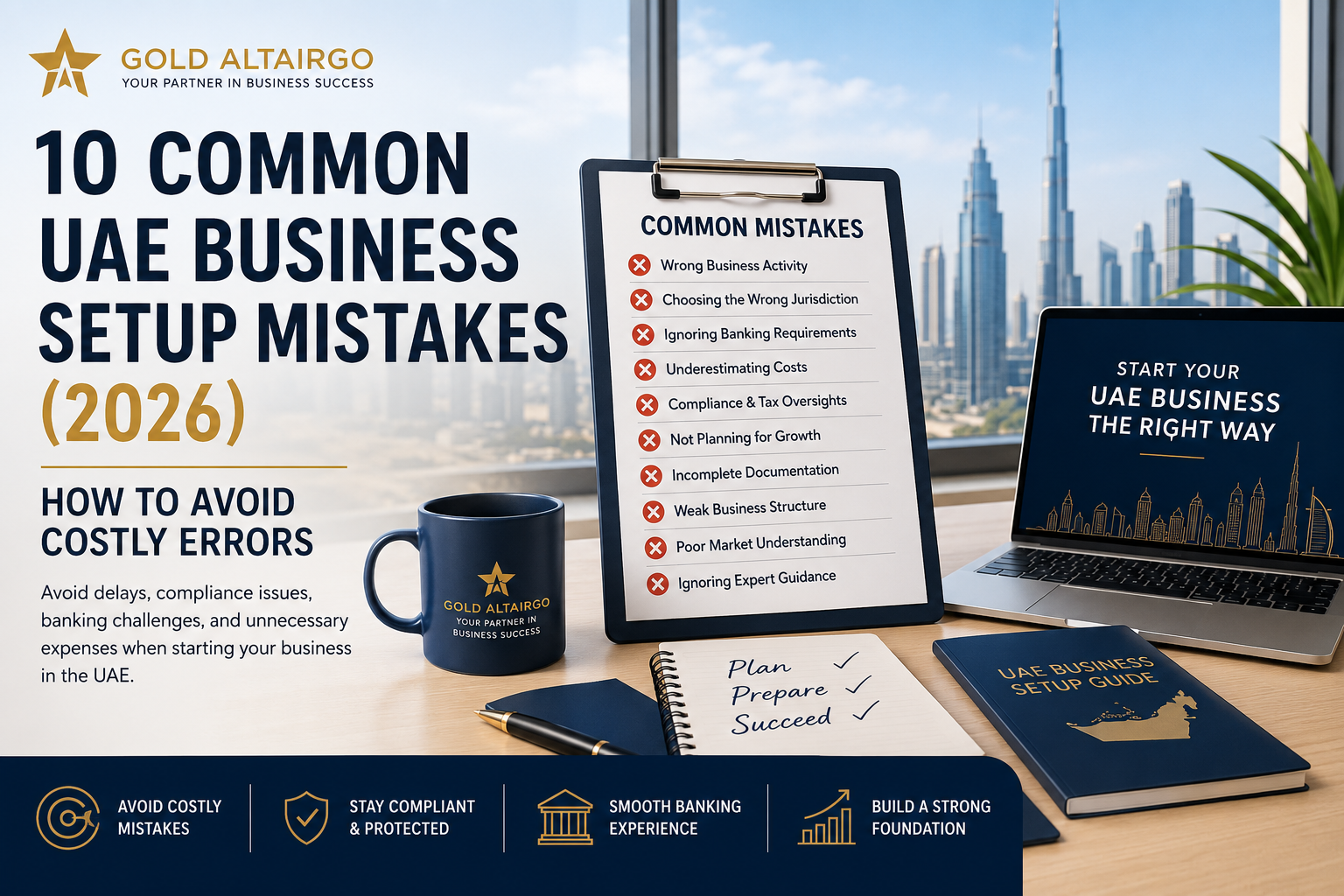
10 Common UAE Business Setup Mistakes (2026): How to Avoid Costly Errors
Starting a business in the UAE? Discover the 10 most common business setup mistakes entrepreneurs make in 2026 and learn practical strategies to avoid delays, banking issues, compliance challenges, and unnecessary costs.
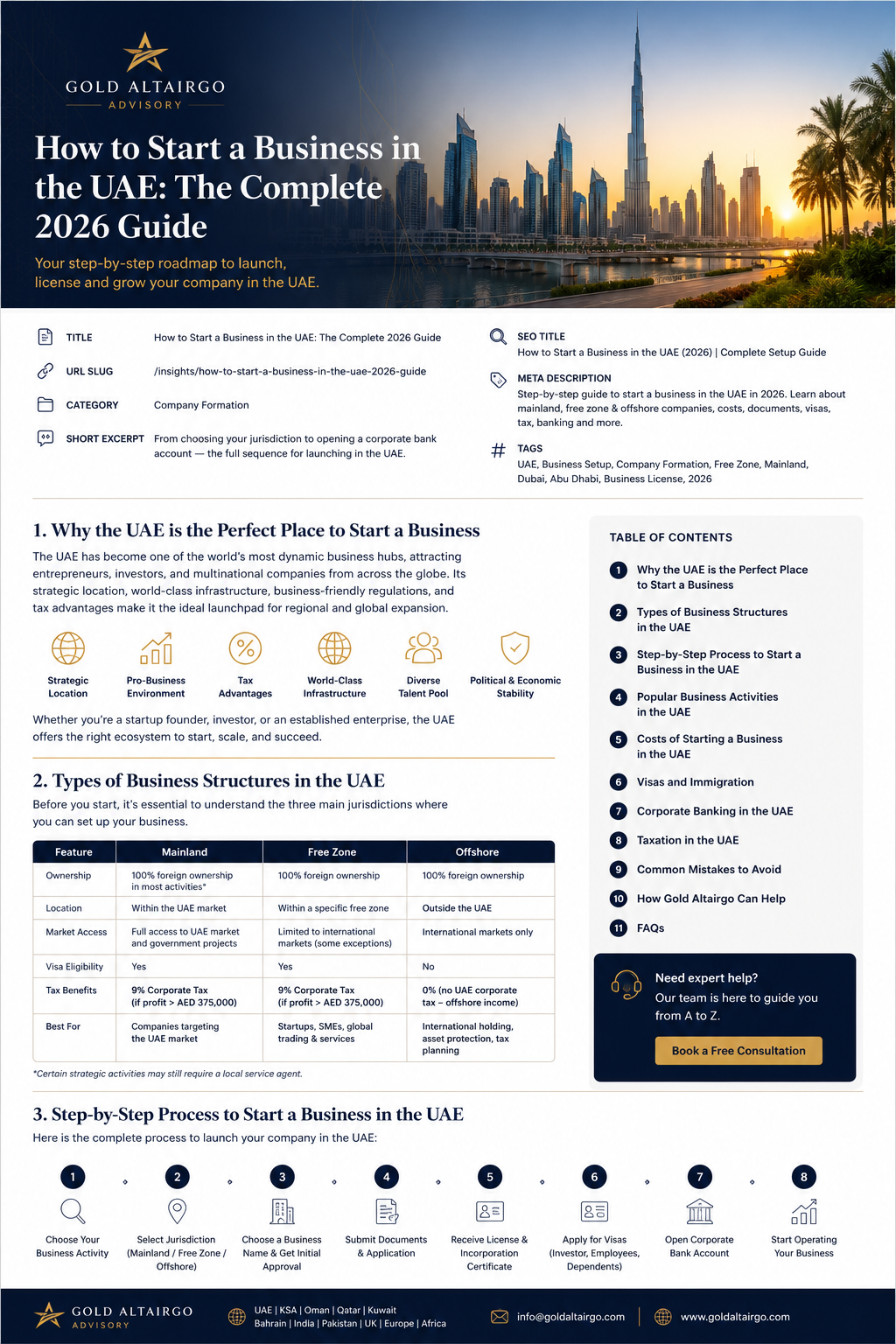
How to Start a Business in the UAE (2026): Complete Step-by-Step Guide
Planning to establish a company in the UAE? This complete guide explains every step—from choosing the right jurisdiction to opening a corporate bank account and growing your business successfully.
Stay ahead with UAE business insights
Monthly briefings from our advisory team: regulatory updates, tax alerts, growth strategies and market opportunities across the UAE and GCC.
- • Business updates and regulatory news
- • Corporate Tax and VAT insights
- • Growth strategies and market opportunities